Consumer Education
Guaranteed Lifetime Income
Annuities are financial products designed to provide guaranteed lifetime income that you cannot outlive. They offer tax-deferred growth, principal protection, and the ability to convert your savings into a predictable income stream for retirement.
What Is An Annuity?
An annuity is a contract with an insurance company where you pay a premium (lump sum or over time) in exchange for guaranteed lifetime income payments in the future. Annuities are designed to protect against outliving your savings — one of the biggest risks in retirement. The insurance company pools your money with other annuity owners and guarantees payments for life, regardless of how long you live or how markets perform. Annuities have been used for retirement planning for over 200 years and are backed by the insurance company's general account and state guaranty associations. Unlike 401(k)s and IRAs that expose you to market risk and longevity risk, annuities transfer these risks to the insurance company. You know exactly how much income you'll receive and when, providing peace of mind and financial security in retirement.
How Do Annuities Work?
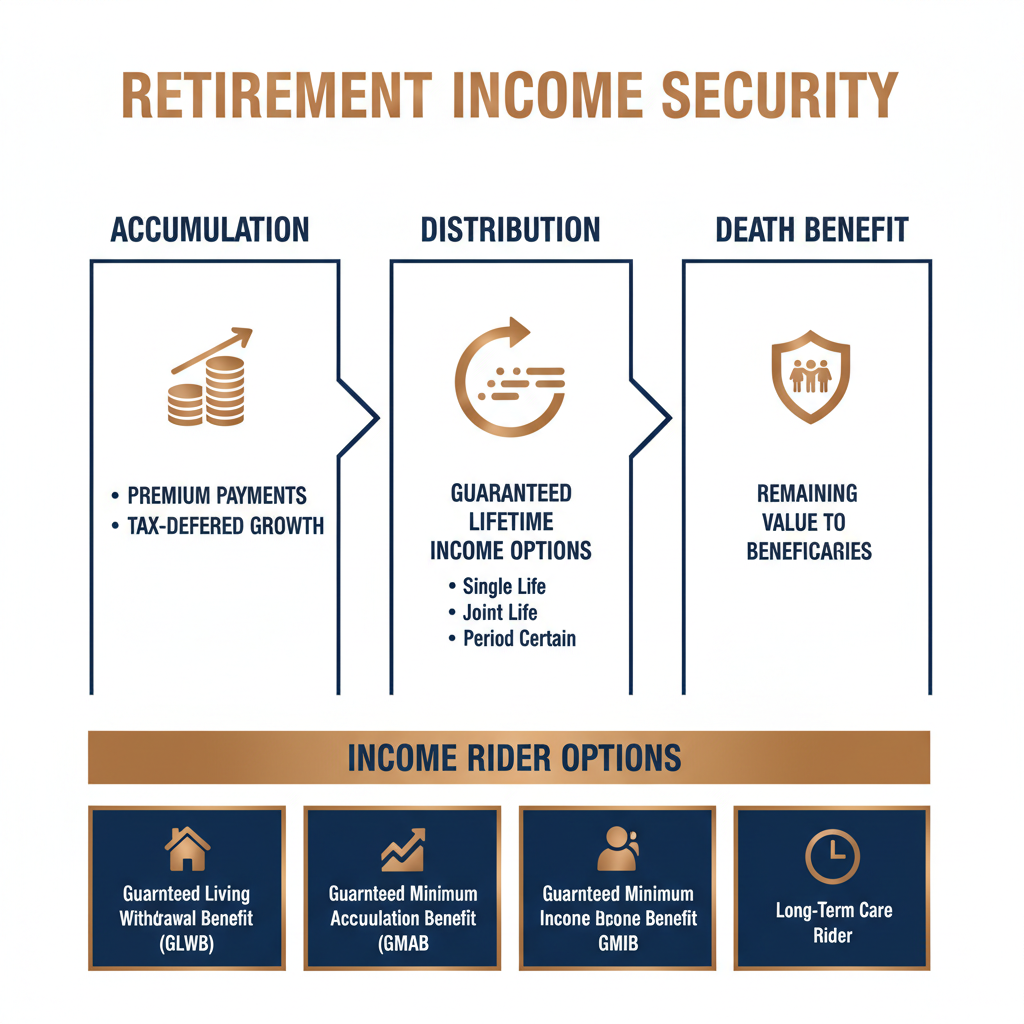
Annuities work in two phases: accumulation and distribution. During the accumulation phase, you contribute money to the annuity (either a lump sum or over time), and it grows tax-deferred. The growth method depends on the annuity type: fixed annuities earn a guaranteed interest rate, indexed annuities earn based on market index performance with downside protection, and variable annuities are invested in subaccounts (like mutual funds) with market exposure but no guarantees. During the distribution phase, the insurance company converts your accumulated value into guaranteed income payments. You can choose when to start receiving income (immediate or deferred), how long payments last (lifetime, joint lifetime, or fixed period), and payment frequency (monthly, quarterly, annually). The insurance company uses actuarial tables to calculate your payment amount based on your age, gender, premium amount, and current interest rates. Once income payments begin, they're guaranteed by the insurance company's financial strength and claims-paying ability.
What Are The Main Types Of Annuities?
Three primary annuity types serve different needs:
- Fixed Annuities — provide guaranteed interest rate during accumulation and guaranteed income payments. Principal is protected, and growth is predictable but modest. Ideal for conservative investors who prioritize safety over growth.
- Fixed Index Annuities (FIAs) — earn interest based on market index performance (S&P 500, NASDAQ) with a floor (typically 0%) protecting against losses. You participate in market gains up to a cap while avoiding market losses. FIAs offer growth potential with downside protection, making them popular for retirement planning.
- Variable Annuities — allow investment in subaccounts (similar to mutual funds) with potential for higher growth but also market risk. Some variable annuities offer optional guaranteed lifetime withdrawal benefits (GLWBs) for additional fees. Variable annuities are suitable for those seeking growth potential with optional income guarantees. Each type has distinct features, costs, and risk profiles. Fixed index annuities have become the most popular choice for retirement planning due to their balance of growth potential and principal protection.
When Do Income Payments Start?
Annuities are classified by when income payments begin:
- Immediate Annuities (SPIAs) — income payments start within 12 months of purchase, typically 30-60 days after funding. You exchange a lump sum for guaranteed lifetime income beginning almost immediately. Ideal for retirees who need income right now and want to eliminate longevity risk.
- Deferred Annuities — income payments start at a future date (5, 10, 20+ years later). During the deferral period, your money grows tax-deferred. At the chosen date, you can annuitize (convert to lifetime income) or take systematic withdrawals. Deferred annuities are ideal for people still accumulating retirement savings who want to lock in future income guarantees. Some deferred annuities offer "guaranteed lifetime withdrawal benefits" (GLWBs) allowing you to take lifetime income without annuitizing, maintaining control over the principal. The choice between immediate and deferred depends on your timeline: immediate for current income needs, deferred for future retirement planning.
What Are The Tax Advantages?
Annuities offer unique tax benefits:
- Tax-Deferred Growth — earnings accumulate tax-deferred during the accumulation phase. You pay no taxes on interest, dividends, or capital gains until you withdraw money. This allows compound growth to work more efficiently than taxable accounts.
- No Contribution Limits — unlike IRAs ($6,500-7,000/year) and 401(k)s ($22,500-30,000/year), annuities have no IRS contribution limits. You can invest unlimited amounts and enjoy tax-deferred growth.
- Tax-Free Exchange — you can exchange one annuity for another via a 1035 exchange without triggering taxes on gains.
- Lifetime Income Taxation — when you annuitize, a portion of each payment is considered return of principal (tax-free) and a portion is earnings (taxable at ordinary income rates). This creates favorable tax treatment compared to fully taxable IRA withdrawals. However, annuities also have tax disadvantages: withdrawals before age 59½ incur a 10% IRS penalty (like IRAs), and earnings are taxed at ordinary income rates (not lower capital gains rates). Annuities are best held in taxable accounts (not IRAs) since IRAs already provide tax-deferred growth.
Are Annuities Safe?
Annuities are among the safest retirement investments:
- Principal Protection — fixed and fixed index annuities guarantee your principal won't decrease due to market losses. Your contract value is protected by the insurance company's general account.
- Guaranteed Income — once annuitized, income payments are guaranteed by the insurance company's claims-paying ability, regardless of market performance or how long you live.
- State Guaranty Associations — every state has a guaranty association protecting annuity owners if an insurance company fails. Coverage limits vary by state (typically $100,000-500,000 in cash value and $100,000-250,000 in income benefits).
- Insurance Company Regulation — insurance companies are heavily regulated by state insurance departments, required to maintain reserves, and undergo regular financial examinations.
- Conservative Investments — insurance companies invest annuity premiums conservatively (mostly bonds and mortgages), prioritizing safety over high returns. However, annuities aren't risk-free: insurance companies can fail (though rare), inflation can erode purchasing power of fixed payments, and surrender charges apply if you withdraw money early (typically 7-15 years). Research insurance company financial strength ratings (A.M. Best, Standard & Poor's, Moody's) and choose highly-rated carriers (A or better).

What Are Surrender Charges?
Surrender charges are fees for withdrawing money from an annuity during the early years of the contract. Most annuities have surrender periods of 7-15 years, during which withdrawals exceeding a penalty-free amount (typically 10% per year) incur surrender charges. Surrender charges start high (7-10% in year 1) and decline annually (1% per year), disappearing after the surrender period. For example, a 10-year surrender schedule might be: Year 1: 10%, Year 2: 9%, Year 3: 8%, continuing down to 0% in Year 11. Surrender charges protect insurance companies from early withdrawals and allow them to invest premiums in longer-term assets. Some annuities offer waiver provisions: surrender charges may be waived for nursing home confinement, terminal illness, or death. Many annuities allow 10% penalty-free withdrawals annually even during the surrender period. It's crucial to understand surrender charges before purchasing — only invest money you won't need for at least the surrender period. Some carriers offer "no-surrender" annuities with lower caps or fees instead of surrender charges.
Can I Access My Money If Needed?
Yes, annuities offer some liquidity options:
- Penalty-Free Withdrawals — most annuities allow withdrawing up to 10% of account value annually without surrender charges, even during the surrender period.
- Nursing Home Waiver — many annuities waive surrender charges if you're confined to a nursing home for 90+ days.
- Terminal Illness Waiver — surrender charges may be waived if diagnosed with a terminal illness (life expectancy under 12 months).
- Death Benefit — upon death, beneficiaries receive the account value (or guaranteed minimum) free of surrender charges.
- Annuitization — once annuitized, you receive regular income payments but lose access to the lump sum.
- Guaranteed Lifetime Withdrawal Benefits (GLWBs) — optional riders allowing lifetime income withdrawals without annuitizing, maintaining control over the principal. However, annuities are designed for long-term retirement income, not short-term savings. Withdrawing large amounts early can deplete the account and reduce lifetime income potential. Before purchasing, ensure you have adequate emergency savings outside the annuity for unexpected expenses.
What Happens To My Money When I Die?
Annuities offer several death benefit options:
- Account Value — if you die before annuitizing, beneficiaries receive the full account value (your contributions plus earnings), free of surrender charges. This is the standard death benefit.
- Guaranteed Minimum Death Benefit — some annuities guarantee beneficiaries receive at least the total premiums paid, even if account value has declined.
- Annuitized Death Benefits — if you've annuitized, death benefits depend on the payout option chosen: Life Only — payments stop at your death, no benefit to beneficiaries (highest payment amount). Life with Period Certain — payments continue to beneficiaries for a guaranteed period (10, 15, 20 years) even if you die early. Joint and Survivor — payments continue to your spouse for their lifetime after your death (slightly lower payment amount).
- Return of Premium — some annuities guarantee beneficiaries receive remaining premiums if you die before receiving total payments equal to your premium. Unlike life insurance, annuity death benefits are generally not income tax-free — beneficiaries pay ordinary income tax on earnings (though they can spread taxation over their lifetime via "stretch" provisions). Annuities bypass probate when beneficiaries are named, providing immediate access to funds.

Who Should Consider Annuities?
Annuities are ideal for:
- Retirees or near-retirees seeking guaranteed lifetime income to cover essential expenses (housing, food, healthcare) that Social Security and pensions don't fully cover.
- Conservative investors worried about market volatility and sequence-of-returns risk near or in retirement.
- Individuals concerned about outliving their savings (longevity risk), especially those with family history of longevity.
- People who have maxed out other tax-advantaged accounts (401(k), IRA) and want additional tax-deferred growth.
- Those seeking principal protection with growth potential (fixed index annuities).
- Individuals wanting to create predictable retirement income and reduce financial stress. Annuities may not be suitable for: people who need immediate access to their money (within 7-15 years), those seeking maximum growth potential (stocks offer higher long-term returns), individuals with limited liquid assets (keep emergency funds outside annuities), or people in poor health with short life expectancy (may not live long enough to benefit from lifetime income guarantees). Annuities work best as part of a diversified retirement plan, complementing Social Security, pensions, 401(k)s, and other investments to create a reliable income floor.