Consumer Education
Supplementary Coverage
Supplementary Health Insurance Guide 2026 - Critical Illness, Dental & Vision
Protect yourself beyond the basics. Critical Illness, Dental, and Vision coverage fill the gaps your primary health insurance leaves behind — keeping you and your family financially secure when it matters most.
Supplementary Coverage: Your Questions Answered
What Is Critical Illness Insurance?
Critical Illness Insurance is a specialized policy that pays a lump-sum cash benefit when you're diagnosed with a covered critical illness or experience a serious medical event. Covered conditions typically include cancer, heart attack, stroke, end-stage renal disease (ESRD), coronary artery bypass surgery, and other life-threatening conditions. The benefit is paid directly to you — not your doctors or hospitals — giving you complete flexibility to use the money however you need. Unlike health insurance that pays medical providers, critical illness insurance provides financial support during your recovery. The average cancer patient faces $50,000+ in out-of-pocket costs beyond what health insurance covers, including deductibles, copays, experimental treatments, travel for specialized care, and living expenses during treatment. Critical illness insurance helps fill this gap, providing financial security when you're most vulnerable. Benefits are typically $10,000-$100,000+ depending on the policy and premium you choose.
Critical Illness Insurance Explained
How Does Critical Illness Coverage Work?
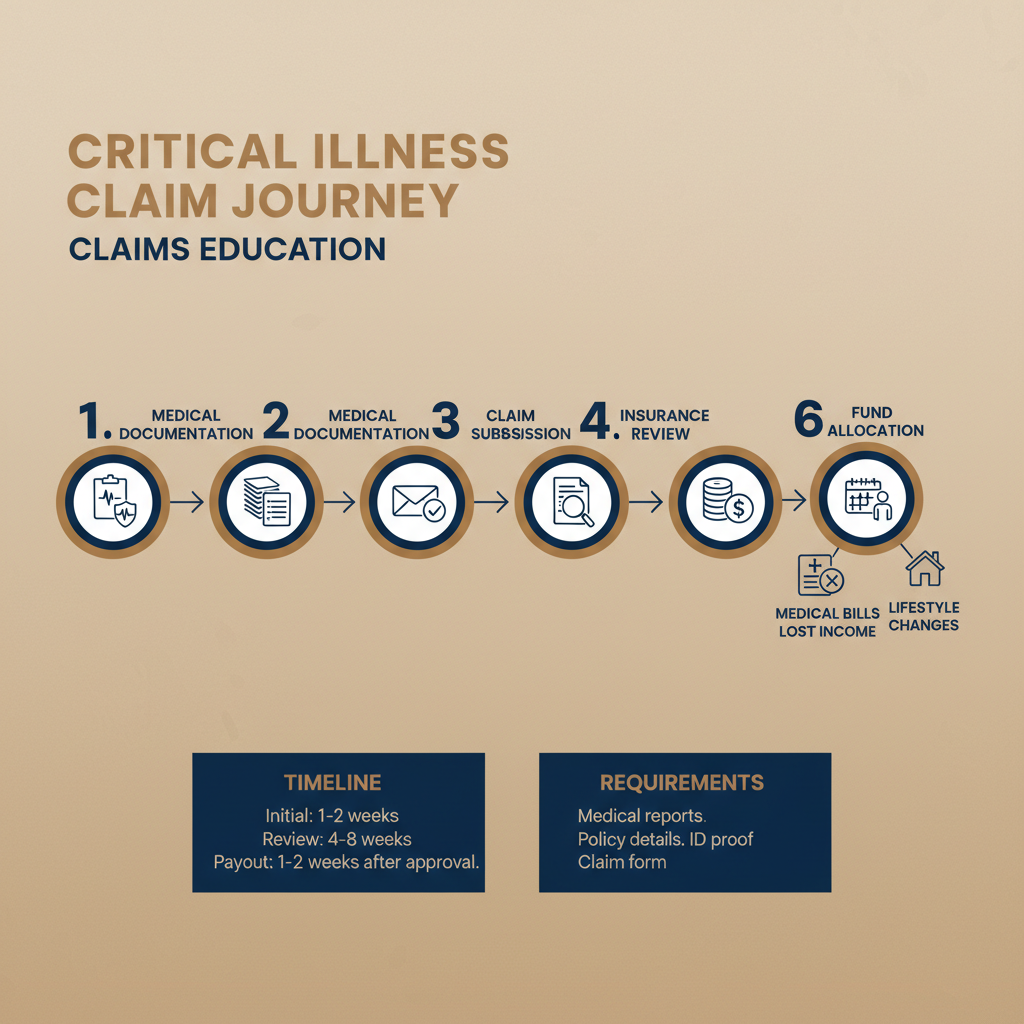
Critical illness insurance works in four simple steps:
- You purchase a policy with a chosen benefit amount ($10,000, $25,000, $50,000, $100,000, etc.) and pay monthly or annual premiums.
- You're diagnosed with a covered condition — cancer, heart attack, stroke, kidney failure, major organ transplant, paralysis, blindness, or other specified illnesses.
- You file a claim with your insurance company, providing medical documentation of the diagnosis.
- Upon approval, you receive a lump-sum cash payment directly — typically within 30 days. The money is yours to use for any purpose: medical bills, mortgage payments, car payments, groceries, utilities, travel for treatment, experimental therapies not covered by health insurance, home modifications for disability, or even taking time off work. There are no restrictions on how you spend the benefit. Most policies pay the full benefit amount for any covered condition, though some have reduced benefits for less severe conditions (like early-stage cancer or mini-stroke/TIA).
What Conditions Are Covered?
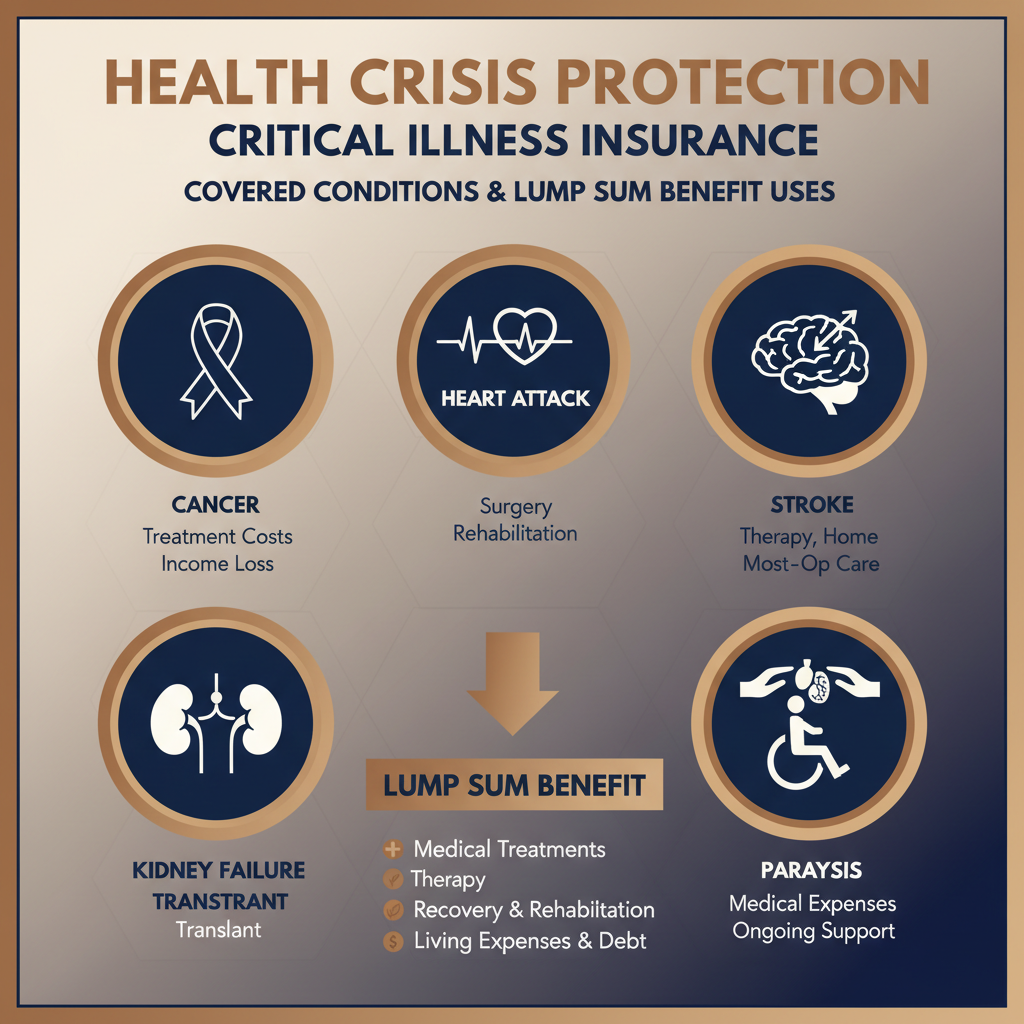
Coverage varies by policy, but most critical illness plans cover:
- Cancer — all types except early-stage skin cancer. Some policies cover early-stage cancer at reduced benefits (25-50% of face amount).
- Heart Attack — myocardial infarction meeting specific diagnostic criteria (elevated cardiac enzymes, ECG changes, chest pain).
- Stroke — cerebrovascular accident with neurological deficits lasting 24+ hours.
- End-Stage Renal Disease — permanent kidney failure requiring dialysis or transplant.
- Coronary Artery Bypass Surgery — open-heart surgery to treat coronary artery disease.
- Major Organ Transplant — receiving or waiting for heart, lung, liver, kidney, or bone marrow transplant.
- Paralysis — loss of function in two or more limbs.
- Blindness — total and irreversible loss of sight.
- Coma — unconscious state lasting 96+ hours.
- Multiple Sclerosis, ALS (Lou Gehrig's Disease), Parkinson's Disease, and other degenerative neurological conditions. Some policies also cover: severe burns, loss of limbs, occupational HIV infection, and bacterial meningitis. Always review the specific covered conditions list — policies vary significantly in what's included and the diagnostic criteria required.
How Much Does Critical Illness Insurance Cost?
Premiums depend on age, health, benefit amount, and policy features. Sample monthly premiums for a $50,000 benefit: Age 30: $20-35/month, Age 40: $30-50/month, Age 50: $50-80/month, Age 60: $80-150/month. Women typically pay 20-30% less than men due to lower incidence rates for certain conditions. Smokers pay significantly higher rates. Premium factors include:
- Benefit Amount — higher benefits cost proportionally more.
- Policy Type — standalone policies cost more than riders attached to life insurance.
- Covered Conditions — policies covering 20+ conditions cost more than basic 6-condition plans.
- Return of Premium — optional rider refunding premiums if you never claim (adds 50-100% to cost).
- Survival Period — some policies require surviving 14-30 days after diagnosis (shorter periods cost more). Many employers offer critical illness insurance as a voluntary benefit at group rates (30-50% lower than individual policies). Individual policies are portable — you keep coverage if you change jobs. Despite the cost, critical illness insurance is considered affordable compared to the financial devastation of a serious illness without coverage.
What Is Dental Insurance?
Dental Insurance is a specialized health insurance plan covering dental care services that standard medical insurance excludes. Most medical plans (including Medicare) provide zero dental coverage for adults, yet oral health is crucial to overall health — gum disease is linked to heart disease, diabetes complications, respiratory infections, and adverse pregnancy outcomes. Dental insurance makes preventive and necessary dental care affordable through a network of participating dentists who accept negotiated fees. Plans typically cover:
- Preventive Care (100%) — cleanings, exams, X-rays, fluoride treatments, sealants.
- Basic Services (70-80%) — fillings, simple extractions, periodontal scaling, root planing.
- Major Services (50%) — crowns, bridges, dentures, implants, inlays, onlays, root canals.
- Orthodontics (50%) — braces, aligners for children and sometimes adults. Plans have annual maximums ($1,000-$2,500 typically) and may have waiting periods (6-12 months) for major services. Despite limitations, dental insurance significantly reduces out-of-pocket costs and encourages regular preventive care that catches problems early.
Dental Insurance Benefits Explained
How Do Dental Plans Work?
Dental insurance works differently than medical insurance:
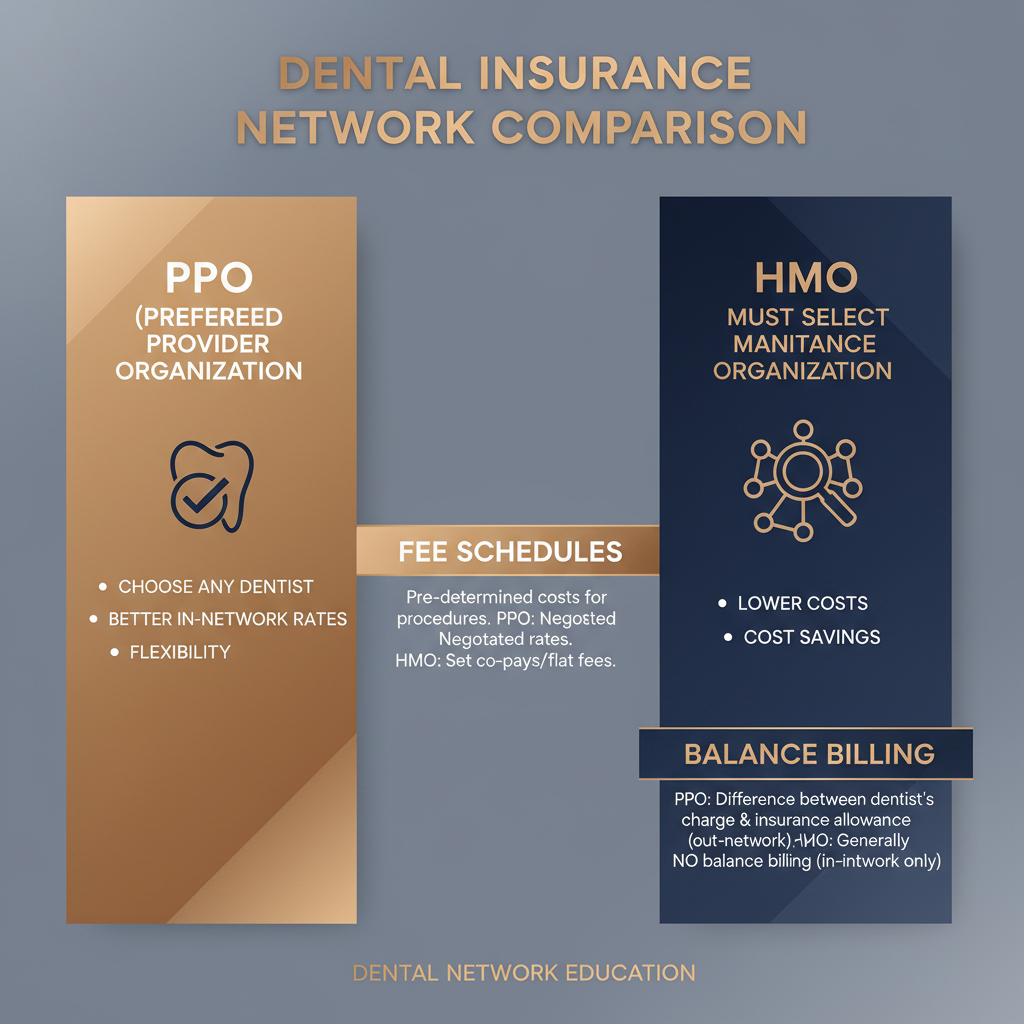
- Network Types — PPO plans allow seeing any dentist but provide better benefits for in-network providers. HMO/DMO plans require using network dentists exclusively.
- Annual Maximum — most plans cap benefits at $1,000-$2,500 per year. Costs beyond this are your responsibility.
- Deductibles — typically $50-100 per person or $150-300 per family annually before coverage begins.
- Coinsurance — you pay a percentage: 0% for preventive, 20-30% for basic, 40-50% for major services.
- Waiting Periods — many plans impose 6-12 month waits for major services (crowns, root canals, implants) to prevent people from buying insurance only when they need expensive work.
- Frequency Limitations — cleanings covered 2x/year, X-rays once per year, replacements limited to once per 5-10 years.
- Missing Tooth Clause — some plans won't cover replacing teeth lost before your coverage started. Understanding these mechanics helps you maximize benefits — use preventive care fully, time major work across benefit years, and choose in-network providers for best value.
What Does Dental Insurance Cost?
Dental insurance is remarkably affordable compared to medical insurance. Individual plans typically cost $20-50/month ($240-600/year). Family plans range $50-150/month ($600-1,800/year). Employer-sponsored plans average $15-30/month per person with employers paying 50-80% of premiums. Despite modest premiums, the value is substantial: two cleanings/exams/X-rays annually ($400-600 value) are typically covered at 100%, essentially paying for the premium. A single filling ($150-300) or crown ($1,000-2,000) can save hundreds or thousands. Consider this example: Family of four pays $100/month ($1,200/year) for a PPO plan with $1,500 annual maximum per person ($6,000 family total). They use preventive care for all four members ($1,600 value), one child needs braces ($4,000 covered at 50% = $2,000 benefit), and one parent needs a crown ($1,500 covered at 50% = $750 benefit). Total benefits: $4,350 vs. $1,200 premium — a 3.6x return. Even without major work, preventive coverage and discounted network fees provide excellent value.
What Is Vision Insurance?
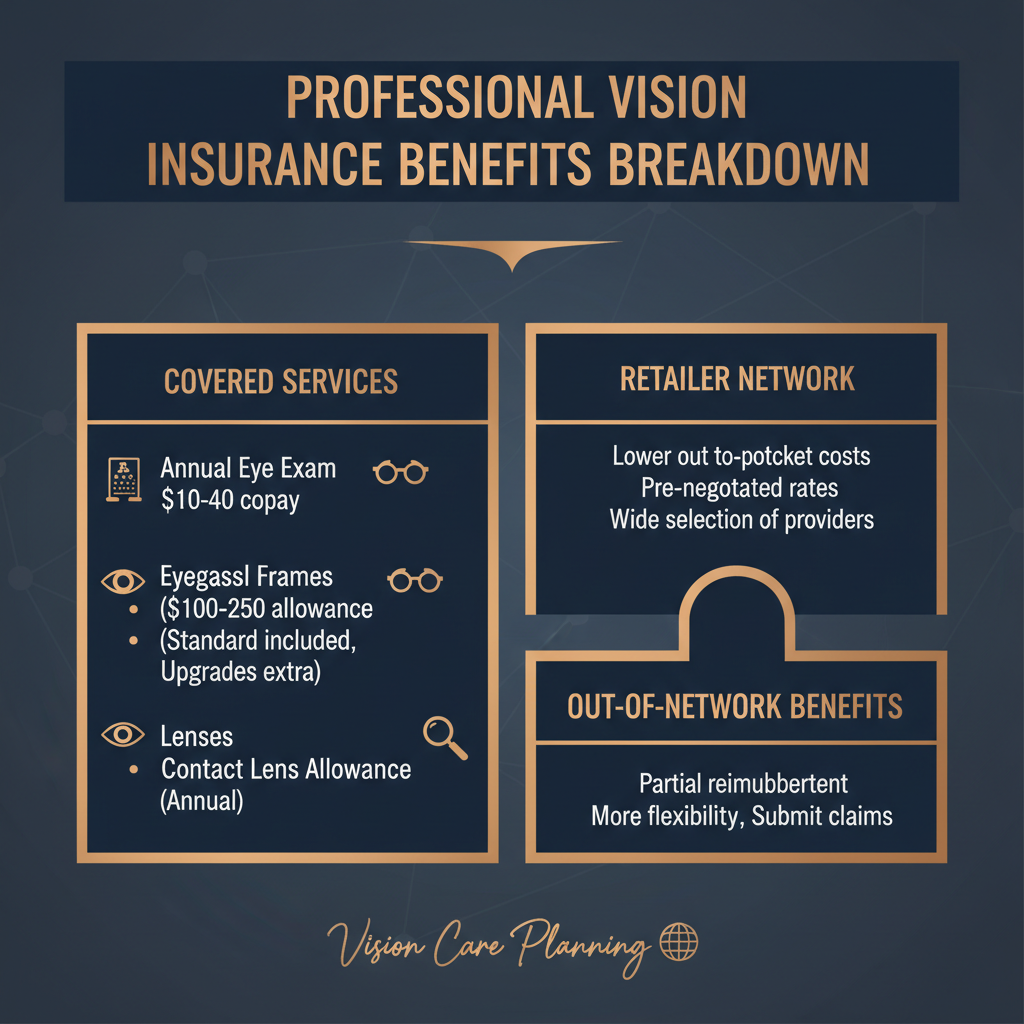
Vision Insurance covers routine eye care and corrective lenses that standard health insurance excludes. While medical insurance covers eye diseases and injuries, it doesn't cover routine exams, glasses, or contact lenses for vision correction. Vision plans make these essential expenses affordable through negotiated rates and allowances. Typical coverage includes:
- Eye Exams — comprehensive vision exams covered annually or biennially, often with small copays ($10-25).
- Glasses — allowances for frames ($100-250) and lenses (single vision, bifocal, progressive) with discounts on upgrades like anti-reflective coating, photochromic lenses, or high-index materials.
- Contact Lenses — annual allowances ($100-250) or discounts on contacts and fitting fees.
- Discounts — 20-60% off additional eyewear, sunglasses, LASIK surgery, and related services. Vision insurance is particularly valuable for families with children (who often need frequent prescription changes), contact lens wearers, and anyone needing regular vision correction. Plans are very affordable ($10-25/month individual, $20-50/month family) and typically pay for themselves with one pair of glasses or annual contacts supply.
How Do Vision Plans Work?
Vision insurance uses an allowance-based model rather than traditional insurance:
- Network Providers — you see participating optometrists and ophthalmologists who accept negotiated fees. Out-of-network care may receive reduced benefits or reimbursement.
- Exam Copays — comprehensive eye exams typically cost $10-25 copays for in-network providers.
- Frame Allowances — plans provide $100-250 allowances toward frames every 12-24 months. You pay the difference if frames cost more.
- Lens Allowances — basic single-vision lenses often covered at 100%, with upgrades (bifocals, progressives, anti-reflective, photochromic) available at discounted prices.
- Contact Lens Allowances — annual $100-250 allowances or discounts on contacts and fitting fees (fitting often $50-150 extra).
- Frequency — most benefits reset every 12 months, though some plans allow exams every 12 months and glasses/contacts every 24 months.
- LASIK Discounts — many plans offer 15-20% discounts on laser vision correction surgery. The key to maximizing value is using benefits fully each year — even if you don't need new glasses, an annual eye exam is crucial for detecting glaucoma, cataracts, macular degeneration, and systemic conditions like diabetes and high blood pressure.
What Does Vision Insurance Cost?
Vision insurance is among the most affordable insurance products. Individual plans typically cost $10-20/month ($120-240/year). Family plans range $20-50/month ($240-600/year). Employer-sponsored vision coverage averages $5-15/month with employers often paying most of the premium. Despite low cost, the value is clear: Annual eye exam ($100-200 value) covered with $10-25 copay. Glasses: $150 frame allowance + lens coverage saves $200-400 on a typical pair. Contact lenses: $150-250 annual allowance covers 30-50% of yearly supply costs. Example: Individual pays $15/month ($180/year), uses exam ($15 copay), buys glasses with $150 frame allowance and covered lenses ($350 retail value, pays $50 out-of-pocket), and receives $200 contact lens allowance. Total benefits: $515 value vs. $180 premium + $65 out-of-pocket = 2.2x return. Even without purchasing eyewear, the annual exam alone provides preventive health value — eye exams detect glaucoma (often asymptomatic until permanent vision loss), diabetic retinopathy, macular degeneration, and signs of hypertension, stroke risk, and autoimmune diseases.
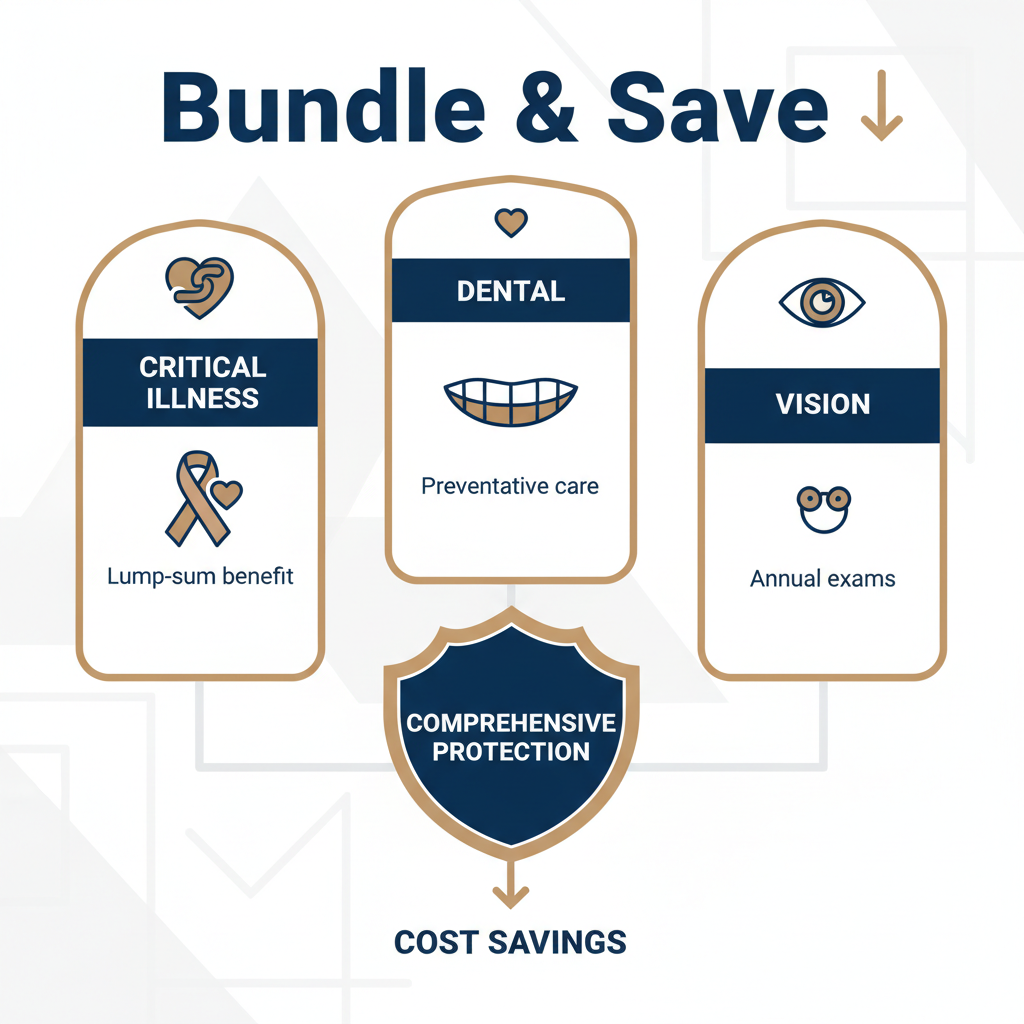
Why Bundle Supplementary Coverages?
Bundling critical illness, dental, and vision coverage provides comprehensive protection at affordable rates. Here's why bundling makes sense:
- Cost Efficiency — purchasing multiple policies from the same carrier often triggers discounts (10-20% off each policy).
- Simplified Management — one billing statement, one renewal date, easier tracking.
- Comprehensive Protection — medical insurance covers doctors and hospitals, but supplementary coverages fill critical gaps: cash for living expenses during illness, dental care for oral health, vision care for eye health.
- Employer Benefits — many employers offer voluntary supplementary benefits at group rates (30-50% below individual premiums) through payroll deduction.
- Tax Advantages — some supplementary premiums qualify for HSA/FSA reimbursement, reducing effective cost with pre-tax dollars.
- Financial Security — the average family faces $50,000+ in unexpected costs during a serious illness. Supplementary coverages provide financial buffers protecting savings and retirement accounts. A typical bundled package might cost $75-150/month for a family — less than most cable bills — while providing $100,000+ in critical illness protection plus dental and vision coverage worth $3,000-5,000 annually in benefits.
Ready to Fill the Gaps?
A licensed professional can help you identify which supplementary coverages make sense for your situation and budget. Schedule a no-obligation consultation today.
Schedule An Appointment →