Consumer Education
Indexed Universal Life Insurance
An Indexed Universal Life Insurance policy is the most flexible, permanent policy available. Not only can YOU decide how best to fund the policy with flexible premiums, you can also change the designed benefits as your needs change. Properly structured, these amazing policies can create a tax-free income stream that you cannot outlive!
Indexed Universal Life Insurance Video
What Is Indexed Universal Life Insurance?
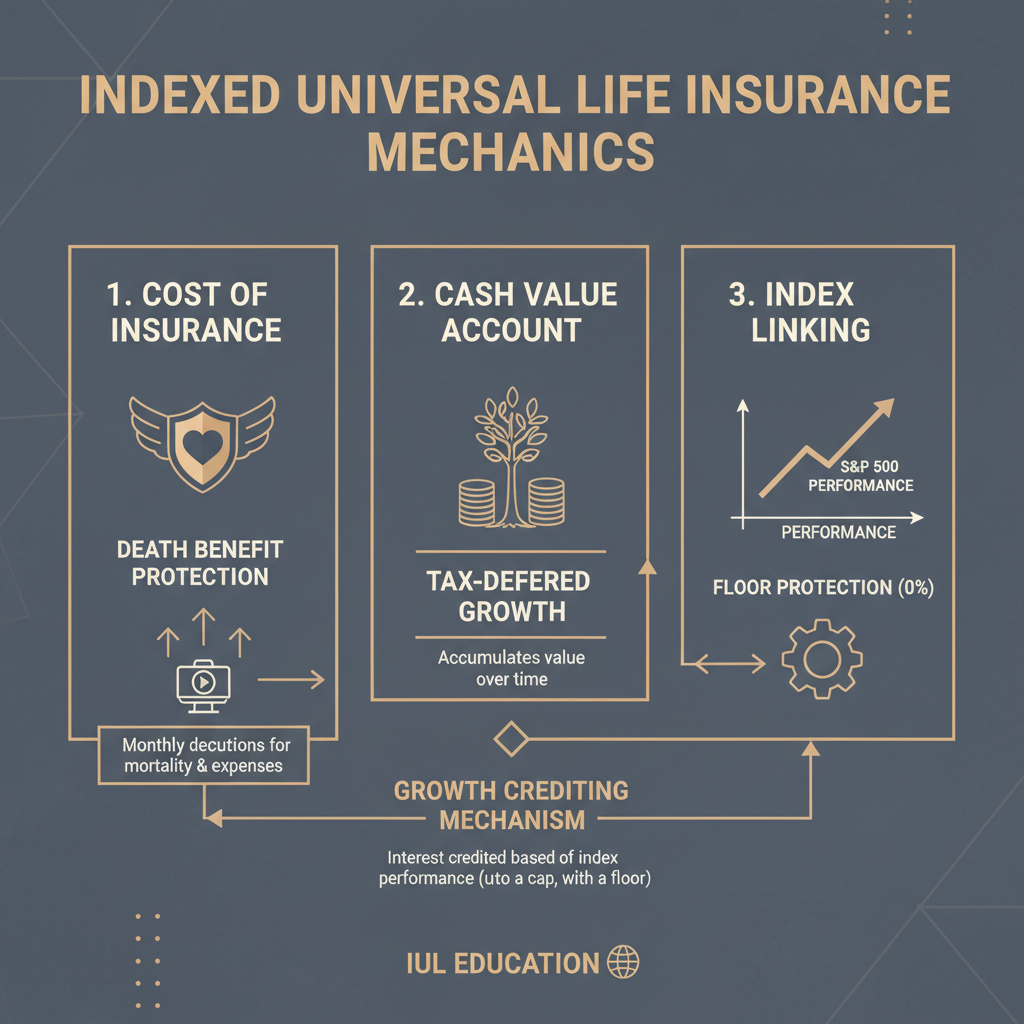
Indexed Universal Life (IUL) insurance is a permanent life insurance policy that combines a death benefit with a cash value account. Unlike traditional whole life, the cash value grows based on the performance of a stock market index (like the S&P 500), but with protection from market losses. You get the potential for growth when the market goes up, while your principal is protected when the market goes down. IUL policies offer flexibility in premium payments and death benefit adjustments, allowing you to adapt the policy as your financial situation evolves. The cash value grows tax-deferred, and when properly structured, can provide tax-free retirement income through policy loans. This makes IUL a powerful tool for both protection and wealth accumulation, bridging the gap between insurance and investment strategies.
How Does The Cash Value Grow?
Your cash value earns interest based on a stock market index performance, subject to a "floor" (typically 0%) and a "cap" (varies by carrier). When the index goes up, your cash value grows up to the cap. When the index goes down, your cash value is protected by the floor — you earn 0% but never lose money. This unique structure provides growth potential with downside protection. The cap rate is determined by the insurance carrier and can change annually based on market conditions and the carrier's portfolio performance. Some policies also offer a participation rate, which determines what percentage of the index gain is credited to your cash value. Additionally, many carriers offer multiple index options (S&P 500, NASDAQ-100, Russell 2000, etc.) and even fixed account options with guaranteed minimum interest rates, allowing you to diversify your cash value growth strategies within the same policy.
What Are The Tax Advantages?
IUL policies offer triple tax advantages:
- Cash value grows tax-deferred — no taxes on annual gains.
- You can access cash value through policy loans tax-free if structured properly.
- Death benefit passes to beneficiaries income tax-free. This makes IUL one of the most tax-efficient retirement planning tools available. Unlike traditional retirement accounts, IUL distributions don't count as taxable income because they're structured as loans against your own cash value. This means you can access your money without triggering a tax event, even in high-tax retirement years. The death benefit also bypasses probate and goes directly to your named beneficiaries, providing immediate liquidity for estate taxes, final expenses, or wealth transfer. For high-income earners facing contribution limits on 401(k)s and IRAs, IUL provides an additional tax-advantaged vehicle with no IRS-imposed funding limits.
How Does The Death Benefit Work?
IUL provides a guaranteed death benefit to your beneficiaries, income tax-free. You can choose between a level death benefit (fixed amount) or an increasing death benefit (face amount plus cash value). You can also adjust the death benefit over time as your needs change — increase it for growing families or decrease it in retirement to reduce costs. The level death benefit option (Option A) keeps the face amount constant while the cash value accumulates separately. The increasing death benefit option (Option B) adds the cash value to the face amount, creating a growing total benefit. You can increase the death benefit with evidence of insurability, or decrease it to lower the cost of insurance charges. This adaptability makes IUL suitable for various life stages — from replacing income for young families to providing estate liquidity for retirees. The death benefit can also be structured to cover specific needs like mortgage payoff, college funding, or charitable giving.
What Happens If The Market Crashes?
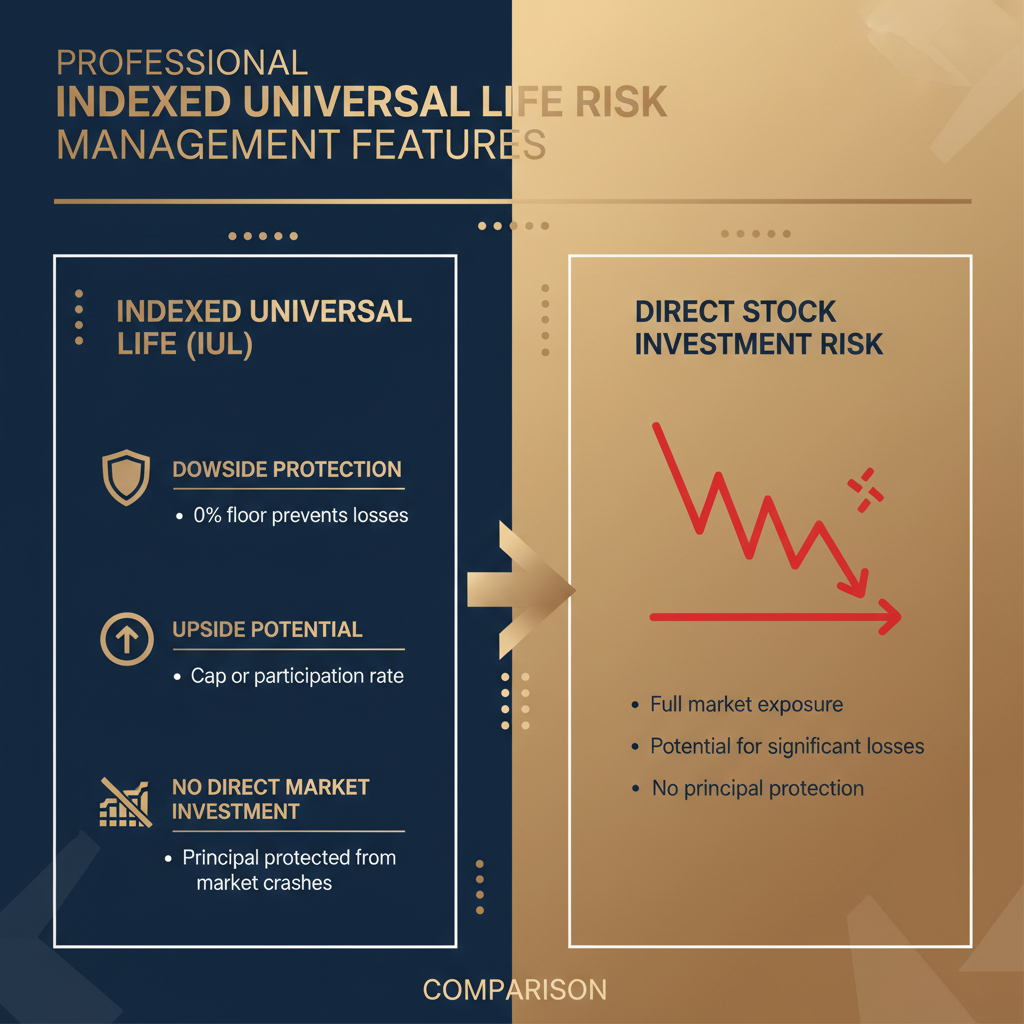
Your cash value is protected. IUL policies have a 0% floor, meaning you never lose cash value due to market declines. In negative index years, you simply earn 0% instead of losing money. This protection makes IUL especially valuable for retirement planning — you avoid sequence-of-returns risk that can devastate 401(k) accounts. This downside protection is the key differentiator between IUL and direct market investments. During the 2008 financial crisis, while 401(k) accounts lost 40-50% of their value, IUL policyholders saw 0% loss — their cash value simply didn't grow that year, but it also didn't shrink. This protection becomes increasingly important as you approach retirement, since you don't need to worry about market timing or recovering from major losses when you're about to start taking distributions. The trade-off for this protection is the cap rate, which limits your upside potential in exchange for eliminating downside risk.
Can I Use IUL For Retirement Income?
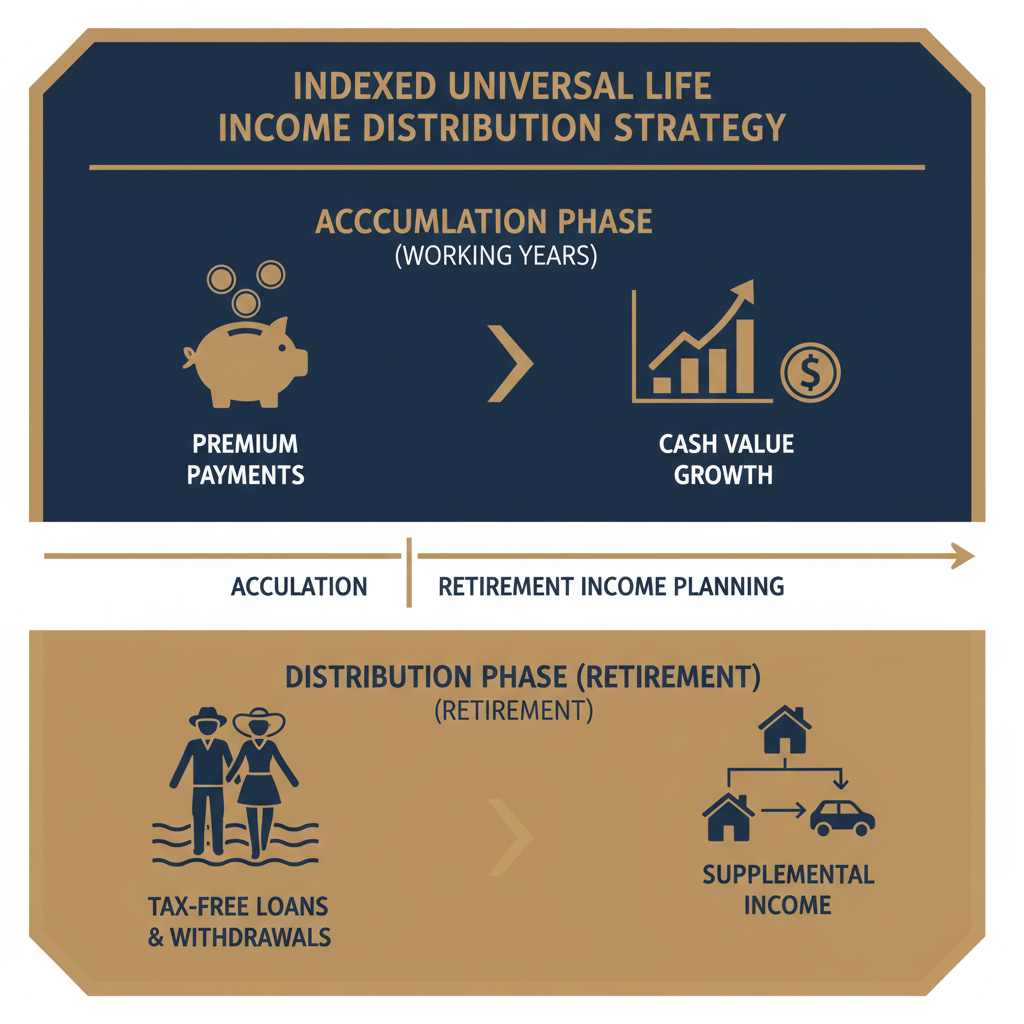
Absolutely! This is one of IUL's most powerful features. Once you've built substantial cash value, you can take tax-free loans against the policy to supplement retirement income. The cash value continues growing even while you take loans, and if structured properly, the policy can provide income for life without running out of money. The strategy involves overfunding the policy during your working years (typically 10-15 years) to build substantial cash value. Once you retire, you begin taking policy loans, which aren't taxable events because you're borrowing against your own money. Meanwhile, the remaining cash value continues to earn index-based growth, potentially offsetting the loan interest. When properly designed with conservative assumptions, the policy can provide guaranteed lifetime income while preserving a death benefit for your heirs. This makes IUL an excellent complement to Social Security, pensions, and traditional retirement accounts, providing tax diversification and protecting against outliving your assets.
What Are The Costs And Fees?
IUL policies have several cost components:
- Cost of Insurance (COI) — covers the death benefit, increases with age.
- Administrative fees — typically $5-15/month.
- Premium loads — some carriers charge upfront percentages.
- Surrender charges — apply if you cancel early (typically 10-15 years). Understanding these costs is critical — work with a professional who provides full transparency. The COI is the largest expense and varies based on your age, health, and death benefit amount. It's deducted from your cash value monthly and increases as you age. Administrative fees cover policy maintenance and are generally modest. Premium loads, when charged, are percentages taken from each premium payment before it's allocated to cash value. Surrender charges decline over time and disappear after the surrender period (usually 10-15 years). Some carriers offer "no-load" policies with higher COI rates instead. It's essential to request a full illustration showing all costs over the policy's lifetime and understand how they impact cash value accumulation. Working with an independent agent who represents multiple carriers allows you to compare fee structures and find the most cost-effective solution for your situation.
How Is IUL Different From 401(k) Or IRA?
Unlike 401(k)s and IRAs, IUL offers:
- No contribution limits — you can fund much more than the $6,500-7,000 IRA limits.
- Tax-free access in retirement vs. taxable withdrawals.
- No required minimum distributions (RMDs) at age 73.
- Downside protection from market losses.
- A death benefit for your family. IUL complements — not replaces — your employer retirement plans. Traditional retirement accounts have strict IRS contribution limits that restrict how much you can save tax-advantaged each year. IUL has no such limits, making it ideal for high-income earners who want to save more. Withdrawals from 401(k)s and IRAs are taxed as ordinary income, while IUL loans are tax-free. At age 73, the IRS forces you to take RMDs from traditional retirement accounts, potentially pushing you into higher tax brackets — IUL has no such requirement. Most importantly, IUL protects your principal from market losses, while 401(k)s and IRAs are fully exposed to market volatility. IUL should be viewed as a complement to, not a replacement for, employer plans — especially if your employer offers matching contributions, which is essentially free money.
Who Should Consider IUL?
IUL is ideal for:
- High-income earners who have maxed out other tax-advantaged accounts.
- Business owners seeking tax diversification.
- Parents wanting to leave a legacy.
- Individuals concerned about market volatility near retirement.
- Anyone seeking tax-free retirement income. IUL works best as a long-term commitment (15+ years) with consistent funding. High-income professionals like doctors, lawyers, and executives who face contribution limits on traditional retirement accounts can use IUL to save additional money tax-advantaged. Business owners appreciate the flexibility to adjust premiums based on cash flow and the ability to access cash value for business opportunities without tax consequences. Parents use IUL to create guaranteed college funding or inheritance for children and grandchildren. Those approaching retirement who are worried about market crashes can shift some 401(k) assets into IUL to protect their principal while maintaining growth potential. The key is understanding that IUL is a long-term commitment — the benefits compound over time, and early surrender can result in significant losses due to surrender charges. Ideal candidates are those who can commit to consistent funding for at least 10-15 years.