Consumer Education
Long Term Care Insurance
Long Term Care policies provide benefits when the insured cannot complete at least 2 of 5 activities of daily living (ADL) due to health condition or cognitive function.
Why You Need Long Term Care Insurance Video
What Is Long Term Care Insurance?
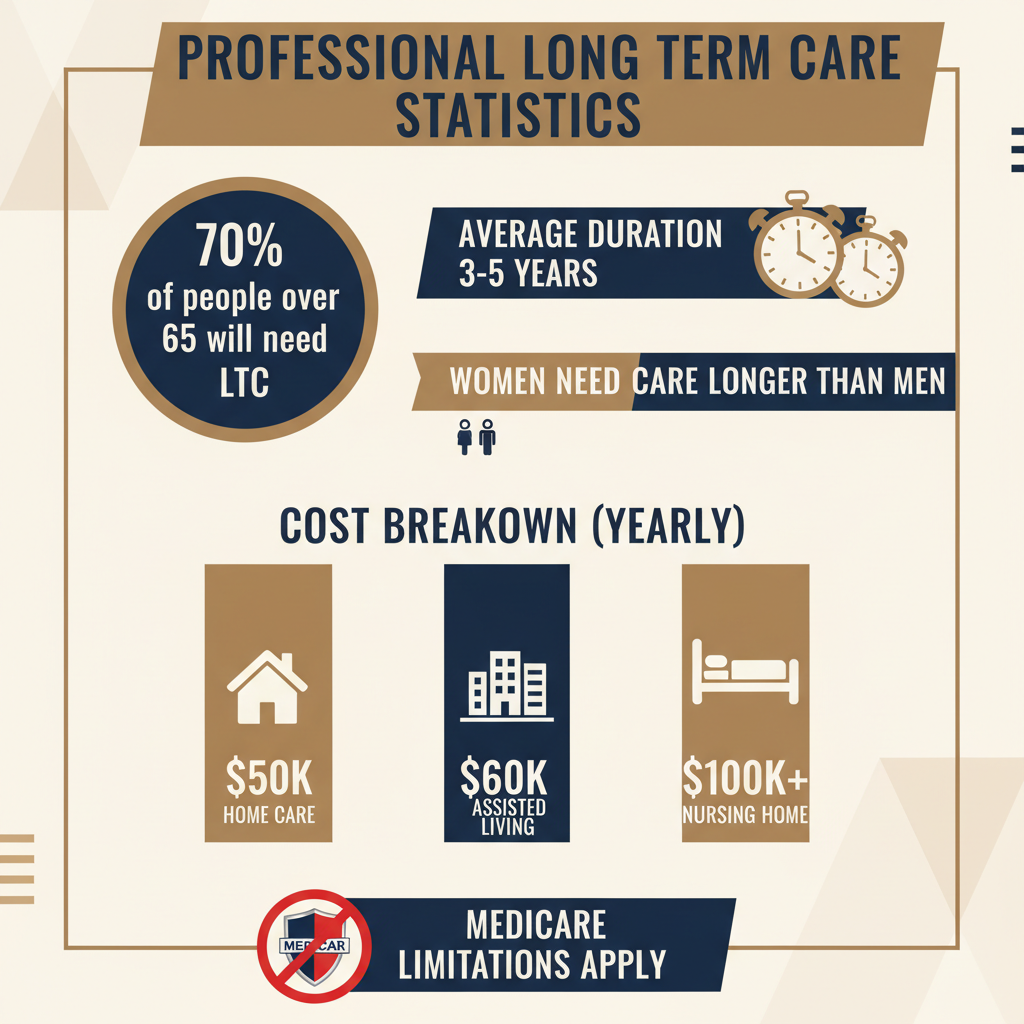
Long Term Care (LTC) insurance helps cover the costs of long-term care services when you're unable to perform basic activities of daily living due to aging, illness, or disability. Unlike health insurance or Medicare, which cover medical treatments, LTC insurance covers custodial care — assistance with daily activities like bathing, dressing, eating, and using the bathroom. Policies typically pay benefits when you cannot perform 2 out of 5 Activities of Daily Living (ADLs) or have severe cognitive impairment. Benefits can be used for care at home, adult day care, assisted living facilities, or nursing homes. With 70% of people over 65 needing some form of long term care and costs averaging $50,000-$100,000+ annually, LTC insurance protects your retirement savings from being depleted by care expenses.
What Services Does LTC Cover?
LTC insurance covers a wide range of care services depending on your policy:
- Home Care — skilled nursing, therapy, or personal care assistants in your own home.
- Adult Day Care — supervised care and social activities during daytime hours.
- Assisted Living — residential facilities providing housing, meals, and personal care assistance.
- Nursing Home Care — 24-hour skilled nursing and custodial care.
- Hospice Care — end-of-life comfort care.
- Respite Care — temporary care giving family caregivers a break.
- Care Coordination — professional assessment and care planning services. Most policies allow you to choose where you receive care, with home care being the most popular option since most people prefer to age in place. Modern policies offer "facility-only" plans (lower premiums) or "comprehensive" plans covering all care settings. Benefits are typically paid as a daily or monthly amount (e.g., $150-300/day or $4,500-9,000/month) based on the geographic area's cost of care.
When Do Benefits Start?
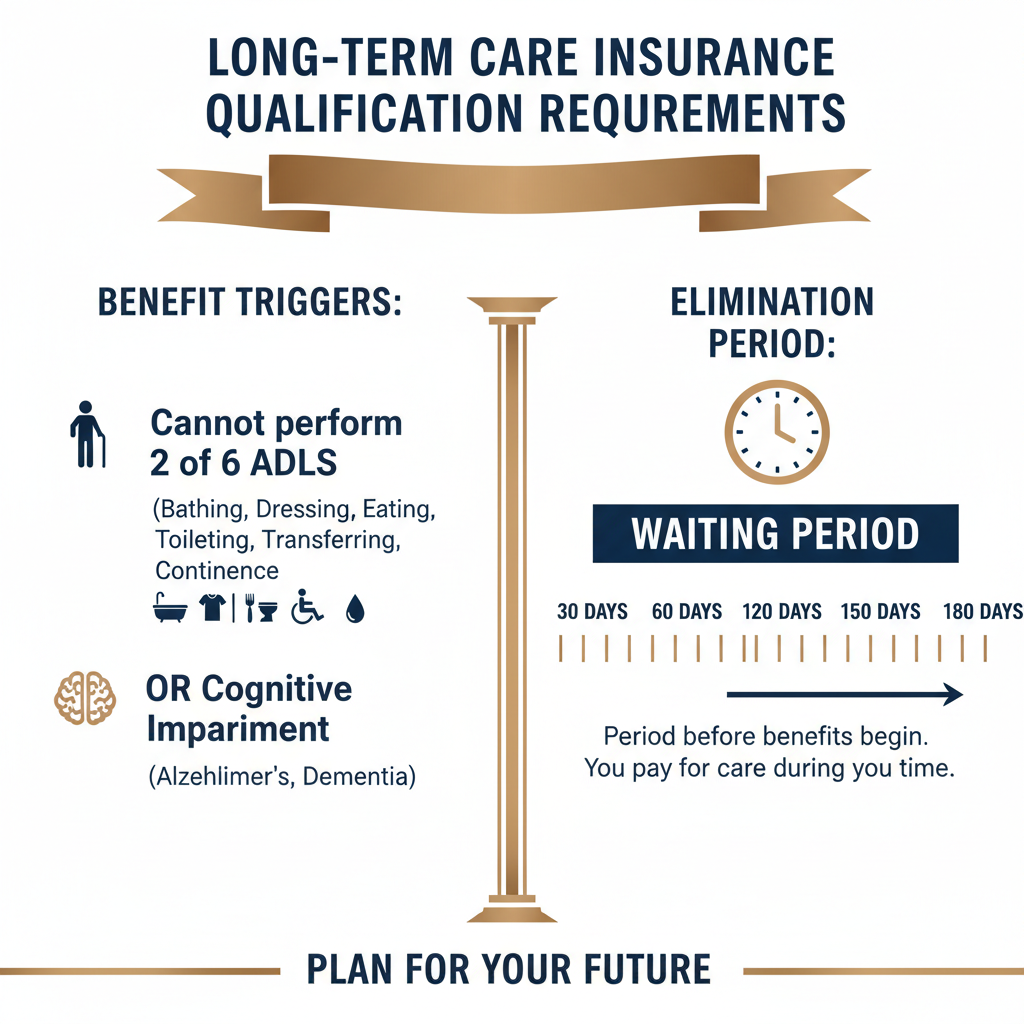
LTC insurance benefits begin when you meet the policy's benefit triggers. The most common trigger is inability to perform 2 out of 5 Activities of Daily Living (ADLs) without substantial assistance:
- Bathing — washing yourself in a shower, tub, or sponge bath.
- Dressing — putting on and taking off clothes.
- Eating — feeding yourself once food is prepared.
- Toileting — using the bathroom and maintaining personal hygiene.
- Transferring — moving in and out of bed or a chair. Alternatively, benefits trigger if you have severe cognitive impairment (Alzheimer's, dementia) requiring substantial supervision. Your doctor must certify that you need care for at least 90 days. Most policies have an elimination period (waiting period) of 30, 60, or 90 days — similar to a deductible — where you pay for care out-of-pocket before benefits begin. Longer elimination periods mean lower premiums. Once you've satisfied the elimination period, the insurance company pays benefits for covered services up to your policy's daily/monthly maximum.
How Much Does LTC Insurance Cost?
LTC insurance premiums vary significantly based on age, health, benefit amount, benefit period, and elimination period. As general guidelines for a comprehensive policy with $150/day benefit, 3-year benefit period, and 90-day elimination period: Age 50: $800-1,200/year ($67-100/month), Age 55: $1,000-1,600/year ($83-133/month), Age 60: $1,400-2,200/year ($117-183/month), Age 65: $2,000-3,500/year ($167-292/month). Women pay more than men due to longer life expectancy and higher likelihood of needing care. Married couples often receive 10-15% discounts. Premiums are guaranteed for life on most policies, though some carriers have rate increase histories. Factors affecting cost: benefit amount (higher daily benefit = higher premium), benefit period (lifetime coverage costs more than 3-5 years), elimination period (90 days costs less than 30 days), inflation protection (compound inflation adds 40-60% to premium but is highly recommended), and health rating (preferred health discounts available). Buying younger locks in significantly lower rates and makes qualification easier.
What Is Inflation Protection?
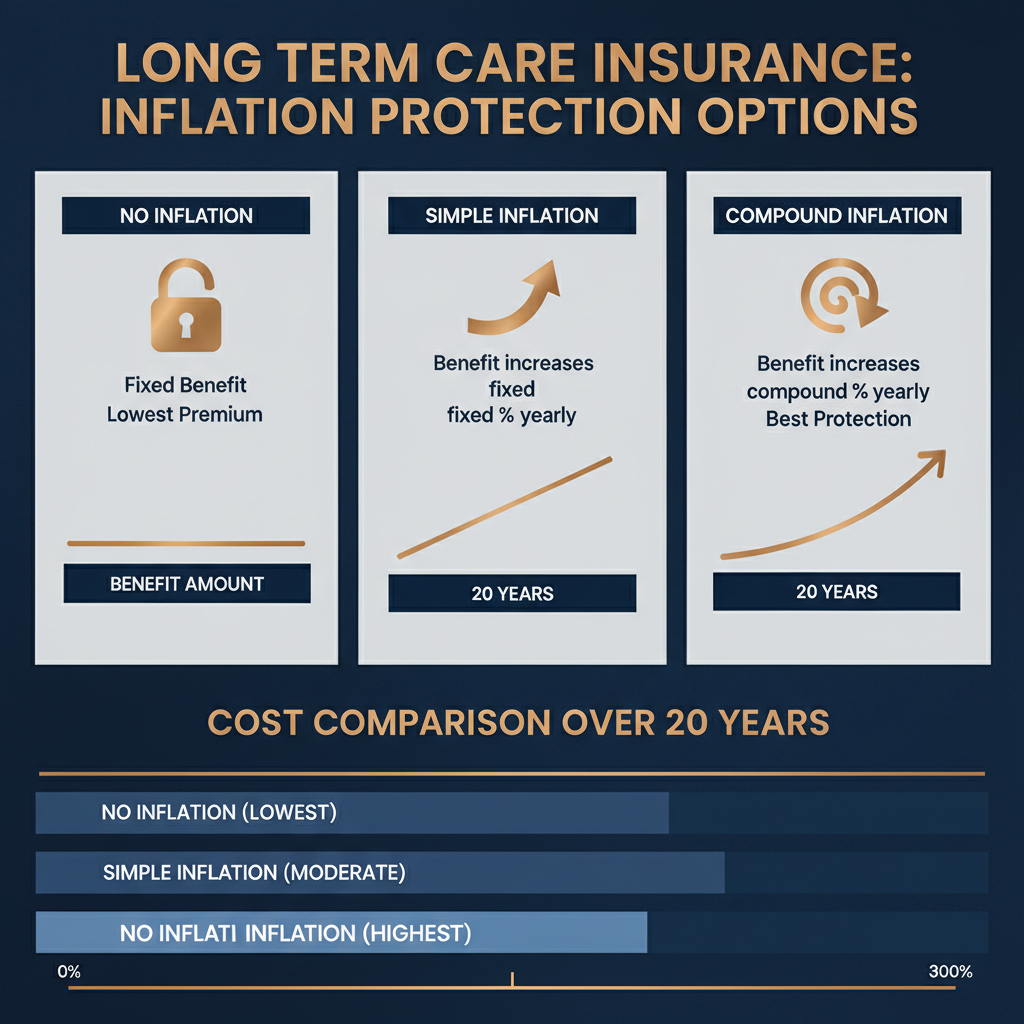
Inflation protection is crucial for LTC insurance because care costs rise 4-6% annually — doubling every 12-15 years. Without inflation protection, a $150/day benefit purchased at age 55 might only have the purchasing power of $50-75/day by age 85. Three types of inflation protection:
- Simple Inflation — benefit increases by a fixed percentage (typically 5%) of the original benefit each year. A $150/day benefit grows to $225/day after 10 years.
- Compound Inflation — benefit increases by a fixed percentage of the previous year's benefit, creating exponential growth. A $150/day benefit with 5% compound inflation grows to $244/day after 10 years and $395/day after 20 years. This is the most recommended option.
- CPI-Based Inflation — benefit increases based on Consumer Price Index changes, with caps (typically 5-6%). Compound inflation protection adds 40-60% to your premium but is considered essential for policies purchased before age 70. Some policies offer "future purchase options," allowing you to increase benefits periodically without additional underwriting. The goal is ensuring your benefit keeps pace with actual care cost increases over the decades until you need care.
How Long Do Benefits Last?
LTC policies offer various benefit periods:
- 2-3 Year Plans — cover short-term care needs, most affordable. Suitable if you have substantial assets to self-insure after the initial period.
- 4-5 Year Plans — cover average care duration (most people need care for 2-5 years). Most popular choice balancing cost and protection.
- 6-10 Year Plans — extended coverage for longer care needs.
- Lifetime/Unlimited Plans — benefits continue as long as you need care, regardless of duration. Most expensive but provides maximum security. Statistics show the average nursing home stay is 2-3 years, but 20% of people need care for 5+ years, and some need care for 10+ years (especially with Alzheimer's). Women typically need care longer than men. Some policies offer "pool of money" designs — instead of a fixed daily benefit for a set number of years, you have a total benefit pool (e.g., $150/day × 1,095 days = $164,250 pool) that can be used flexibly. If you use less than the maximum daily benefit, the pool lasts longer. Unused benefits at death are typically forfeited, though some policies offer return-of-premium riders. The right benefit period depends on your family health history, assets, and risk tolerance.
Does Medicare Cover Long Term Care?
No, Medicare provides very limited long term care coverage. Medicare Part A covers up to 100 days in a skilled nursing facility ONLY after a qualifying 3-day hospital stay, and only for skilled care (rehabilitation, nursing care), not custodial care (assistance with ADLs). After 100 days, Medicare pays nothing for nursing home care. Medicare does NOT cover: long-term custodial care in nursing homes, assisted living facility costs (only medical services), home care for ADL assistance (only skilled home health care temporarily), or adult day care. This is a common misconception — many people assume Medicare will cover their long term care needs, but it doesn't. Medicaid does cover long term care, but only for people with very limited income and assets (typically under $2,000 in countable assets), requiring you to "spend down" your life savings first. This is why LTC insurance is essential — it protects your retirement savings and gives you choices about where and how you receive care, rather than forcing you to deplete assets and rely on Medicaid.
What Happens If I Never Need Care?
Traditional LTC insurance is "use it or lose it" — if you never need long term care, you don't receive benefits, and premiums aren't refunded. This concerns some people, but consider: you've purchased peace of mind and asset protection for decades, similar to how you pay for home insurance without expecting your house to burn down. However, modern alternatives address this concern:
- Hybrid Life/LTC Policies — combine life insurance with LTC benefits. If you need long term care, the policy pays LTC benefits. If you die without needing care, your beneficiaries receive the full death benefit. Premiums are 2-3 times higher than traditional LTC but guarantee a payout.
- Linked-Benefit Policies — similar to hybrids, offering both LTC and death benefits with a single premium or level premiums.
- Return-of-Premium Riders — available on some traditional LTC policies, refunding a portion of premiums if you cancel or die without using benefits. Adds 30-50% to premium costs.
- Cash Value LTC — some permanent life insurance policies include LTC riders, building cash value while providing care coverage. Traditional LTC insurance remains the most cost-effective way to cover long term care risk, especially when purchased in your 50s or early 60s. The "lost" premiums are the cost of protecting your retirement savings from a potentially catastrophic expense.
When Should I Buy LTC Insurance?
The ideal time to buy LTC insurance is between ages 50-60, when you're still healthy enough to qualify easily and premiums are affordable. Waiting even 5-10 years can significantly increase costs or make you uninsurable. Key considerations:
- Health — buy while you're healthy. Pre-existing conditions (diabetes, heart disease, cancer history) can result in higher premiums or denial.
- Age — premiums increase 8-12% for each year you wait. A policy costing $1,500/year at age 55 might cost $3,000+/year at age 65.
- Family History — if parents needed long term care, especially for extended periods, consider buying earlier.
- Assets — if you have substantial retirement savings ($500,000+) you want to protect, LTC insurance makes sense. If you have very limited assets, Medicaid may be your only option.
- Family Support — if family members can't provide care due to distance or work obligations, insurance becomes more important.
- Gender — women should consider buying earlier since they live longer and need care more often. Many people wait too long, hoping they'll never need care, then face denial or unaffordable premiums when health declines. The best time to buy is when you're healthy enough to qualify and wealthy enough to afford premiums but not so wealthy that you can self-insure the risk.