Consumer Education
Mortgage Protection
This overview provides education on the three varieties of mortgage protection options available to today's modern families and savvy individuals.
Mortgage Protection Overview
What Is Mortgage Protection Insurance?
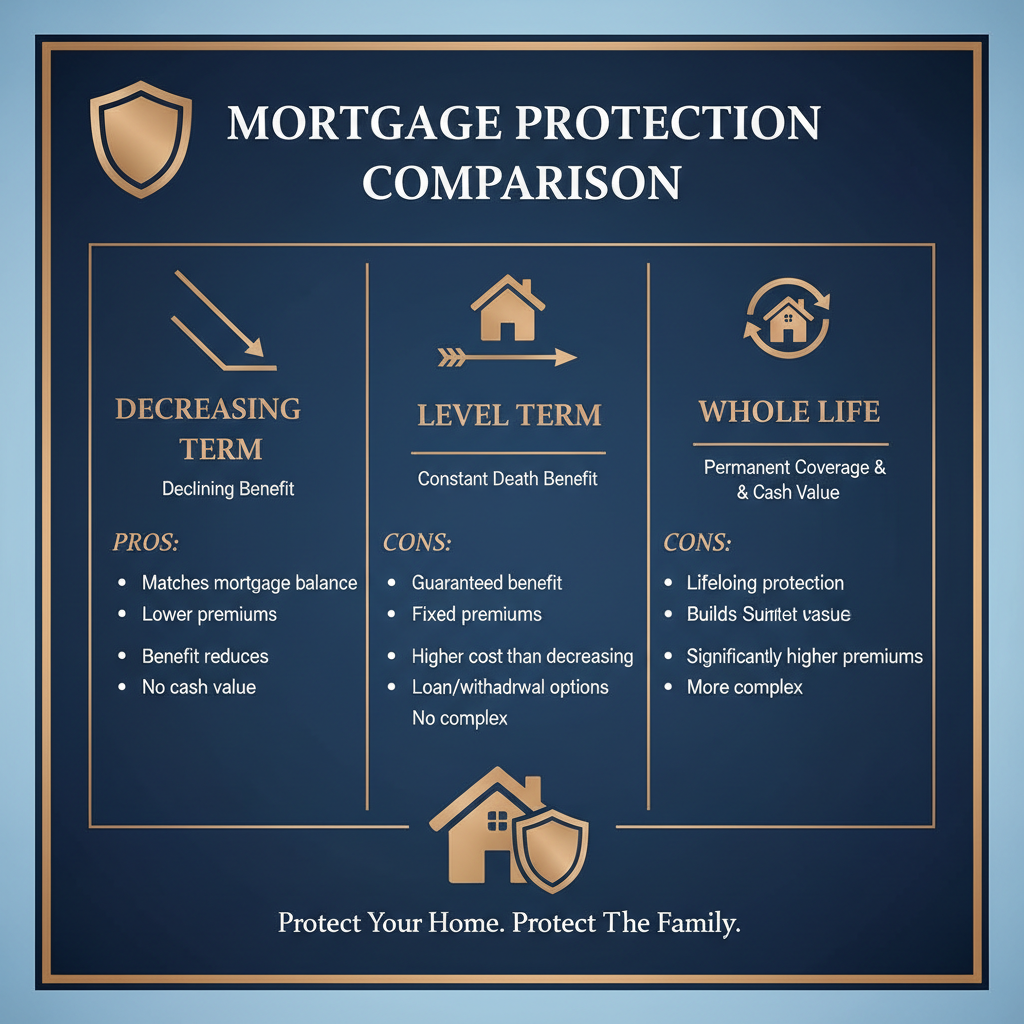
Mortgage protection insurance is life insurance specifically designed to cover your mortgage payments if you die, become disabled, or (in some policies) lose your job. The death benefit is structured to match your mortgage obligation, ensuring your family can keep the home even without your income. There are three main types: decreasing term (benefit matches declining mortgage balance), level term (fixed benefit that can cover the entire mortgage), and mortgage payment protection (covers monthly payments for a set period). Unlike private mortgage insurance (PMI), which protects the lender, mortgage protection insurance protects your family by paying off or covering the mortgage. The average American household carries a $200,000+ mortgage, making it their largest debt. Mortgage protection ensures this debt doesn't become a burden during grief. Benefits are paid directly to beneficiaries, who can use funds to pay off the mortgage, make payments, or refinance. Some policies also offer living benefits for disability or critical illness, providing payment assistance while you're unable to work. Mortgage protection provides peace of mind that your family's home is secure regardless of what happens to you.
What Is Full Mortgage Protection?
Full mortgage protection provides coverage equal to your entire mortgage balance, guaranteeing complete payoff if you die during the term. This is typically structured as a level term life insurance policy with death benefit matching your original mortgage amount. For example, a $300,000, 30-year mortgage would be covered by a $300,000, 30-year term policy. If you die in year 1, year 15, or year 30, the full $300,000 is paid to beneficiaries, who can immediately pay off the mortgage. This provides maximum security — your family owns the home free and clear, with no monthly payments. Full protection is ideal for primary breadwinners whose income is essential for mortgage payments. The death benefit is tax-free and goes directly to beneficiaries, bypassing probate. They can pay off the mortgage immediately or invest the funds and make payments over time. Full protection premiums are higher than partial or equity protection but provide complete peace of mind. This option is particularly valuable for families living paycheck-to-paycheck, where losing income would make mortgage payments impossible. Full protection ensures the family home is permanently secured, providing stability during an emotionally difficult time. Many financial advisors recommend full mortgage protection as the gold standard for families with dependents.
What Is Partial Mortgage Protection?
Partial mortgage protection covers a portion of your mortgage balance, typically 50-75% of the outstanding amount. This approach reduces the mortgage burden while allowing your family to retain home equity. For example, on a $300,000 mortgage, a $150,000-$225,000 policy would pay down a significant portion, and your family could refinance the remaining balance with lower monthly payments. Partial protection is more affordable than full coverage while still providing substantial help. The strategy works well for two-income families where one spouse could afford reduced payments with their income alone. It's also suitable for those with substantial home equity who want to preserve that equity for their family. By paying down a large portion of the mortgage, partial protection gives your family options: refinance the remainder, sell the home with significant equity, or continue payments on a smaller balance. Partial protection premiums are 40-60% lower than full protection, making it accessible for tighter budgets. Some families purchase partial protection initially and increase coverage as finances improve. This approach balances affordability with meaningful protection, ensuring your family isn't forced to sell the home due to unaffordable payments.
What Is Equity Protection?
Equity protection (also called mortgage payment protection) is the most affordable mortgage insurance option, providing 12-24 months of mortgage payments rather than lump-sum payoff. This gives your family time to grieve, adjust finances, and decide the best long-term solution without immediate pressure. For example, if your monthly payment is $2,000, a 24-month equity protection policy provides $48,000 in benefits. This temporary support prevents foreclosure while your family makes informed decisions. Equity protection is ideal for families who need short-term assistance but have long-term income potential (like a working spouse who needs time to find employment or complete training). It's also suitable as a supplement to other coverage or for those who can't afford full or partial protection. The limited duration keeps premiums very affordable — often 70-80% less than full protection. Some policies offer disability benefits, continuing payments if you're unable to work due to illness or injury. Equity protection acknowledges that families need time, not necessarily complete payoff. After the benefit period, your family can decide to sell, refinance, or continue payments based on their situation. This flexibility, combined with low cost, makes equity protection an attractive option for budget-conscious families who still want meaningful protection.
How Much Mortgage Protection Do I Need?
Determining mortgage protection needs requires analyzing your family's specific situation and goals. Consider: your outstanding mortgage balance, monthly payment amount, other debts and obligations, family income sources, spouse's earning potential, children's ages and dependency period, and other life insurance coverage. Full protection ($300,000+ for typical mortgages) is best if: you're the primary breadwinner, your spouse couldn't afford payments alone, you want to guarantee your family keeps the home, or you have limited other life insurance. Partial protection ($150,000-$225,000) works well if: you're a two-income household, your spouse could afford reduced payments, you have other life insurance, or you want to balance protection with affordability. Equity protection (12-24 months of payments) is suitable if: you need temporary assistance, your spouse has income potential but needs transition time, you have other coverage for final expenses, or budget is the primary concern. Many families layer coverage — equity protection for immediate payment relief plus term life insurance for income replacement. Consider your mortgage type: fixed-rate mortgages are predictable, while adjustable-rate mortgages might increase, requiring more coverage. Also factor in other housing costs (property taxes, insurance, maintenance) that your family would need to afford. The goal is ensuring your family has realistic options to keep the home if you die.
Is Mortgage Protection Different From PMI?
Yes, mortgage protection insurance and private mortgage insurance (PMI) are completely different products serving opposite purposes. PMI protects the lender, not you or your family. Lenders require PMI when you put down less than 20% on a home purchase — it insures the lender against default if you stop making payments. PMI provides you no benefit; it's purely for the lender's protection, and you pay the premium. PMI can be cancelled once you reach 20% equity. Mortgage protection insurance, conversely, protects your family by paying off or covering mortgage payments if you die or become disabled. You choose the beneficiaries (typically your spouse or children), and they receive the tax-free benefit. Mortgage protection is optional, while PMI is required by lenders for low-down-payment loans. PMI premiums typically cost 0.5-1% of the loan amount annually (e.g., $100-200/month on a $200,000 loan). Mortgage protection premiums vary based on coverage amount, your age, and health. Many homeowners have both: PMI (required by lender) and mortgage protection (chosen for family protection). Don't confuse the two — PMI doesn't help your family if you die, only mortgage protection does. Understanding this distinction is crucial for proper financial planning.
Can I Use Existing Life Insurance Instead?
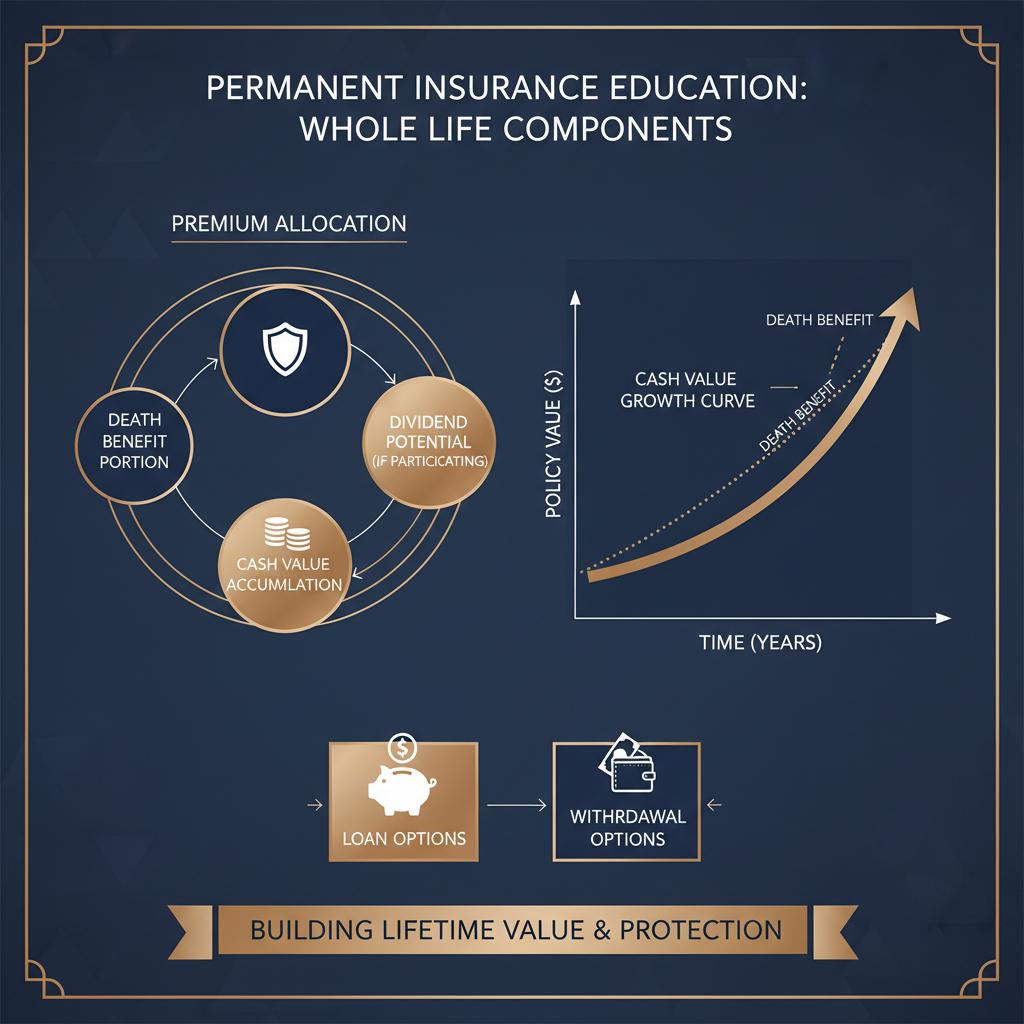
Existing life insurance can serve as mortgage protection if you have adequate coverage and designate proceeds appropriately. Term or whole life policies can pay off mortgages just like dedicated mortgage protection policies. The advantage is simplicity — one policy covers multiple needs (mortgage, income replacement, final expenses). However, many families don't have enough existing coverage. The average American has only $100,000-150,000 in life insurance, while average mortgages exceed $200,000. If you have sufficient existing coverage, ensure beneficiaries know to use proceeds for the mortgage. Some people earmark a specific policy for mortgage protection. The disadvantage of relying solely on existing insurance is that beneficiaries might use funds for other expenses (bills, living costs, education), leaving the mortgage unpaid. Dedicated mortgage protection policies provide clarity — the benefit is specifically for the home. Additionally, mortgage protection can be structured to match the mortgage exactly (decreasing term for declining balance), which general life insurance doesn't do. A hybrid approach works well: existing life insurance for income replacement and final expenses, plus dedicated mortgage protection for the home. This ensures both needs are met without forcing beneficiaries to choose between paying the mortgage and covering living expenses. Review your total coverage to ensure adequate protection for all needs.
What About Disability Coverage?
Many mortgage protection policies include disability benefits, covering mortgage payments if you become disabled and unable to work. This living benefit is often more valuable than the death benefit, since disability is statistically more likely than premature death during working years. Disability mortgage protection typically pays your monthly mortgage payment for a specified period (12-24 months) or until you return to work. Some policies offer own-occupation coverage (pays if you can't work in your specific job) or any-occupation coverage (pays only if you can't work any job). Benefits can be structured as reimbursement (you make payments, insurer reimburses you) or direct payment (insurer pays lender directly). Elimination periods (waiting period before benefits start) range from 30-180 days — longer elimination periods mean lower premiums. Some policies also offer unemployment benefits, covering payments if you lose your job through no fault of your own. This comprehensive protection — death, disability, and sometimes unemployment — ensures your family keeps the home regardless of what happens to your income. Disability mortgage protection is particularly valuable for self-employed individuals, business owners, and those without employer disability coverage. Premiums are higher than death-only coverage but provide crucial protection against the most likely threat to mortgage payments.
Should I Choose Decreasing Or Level Term?
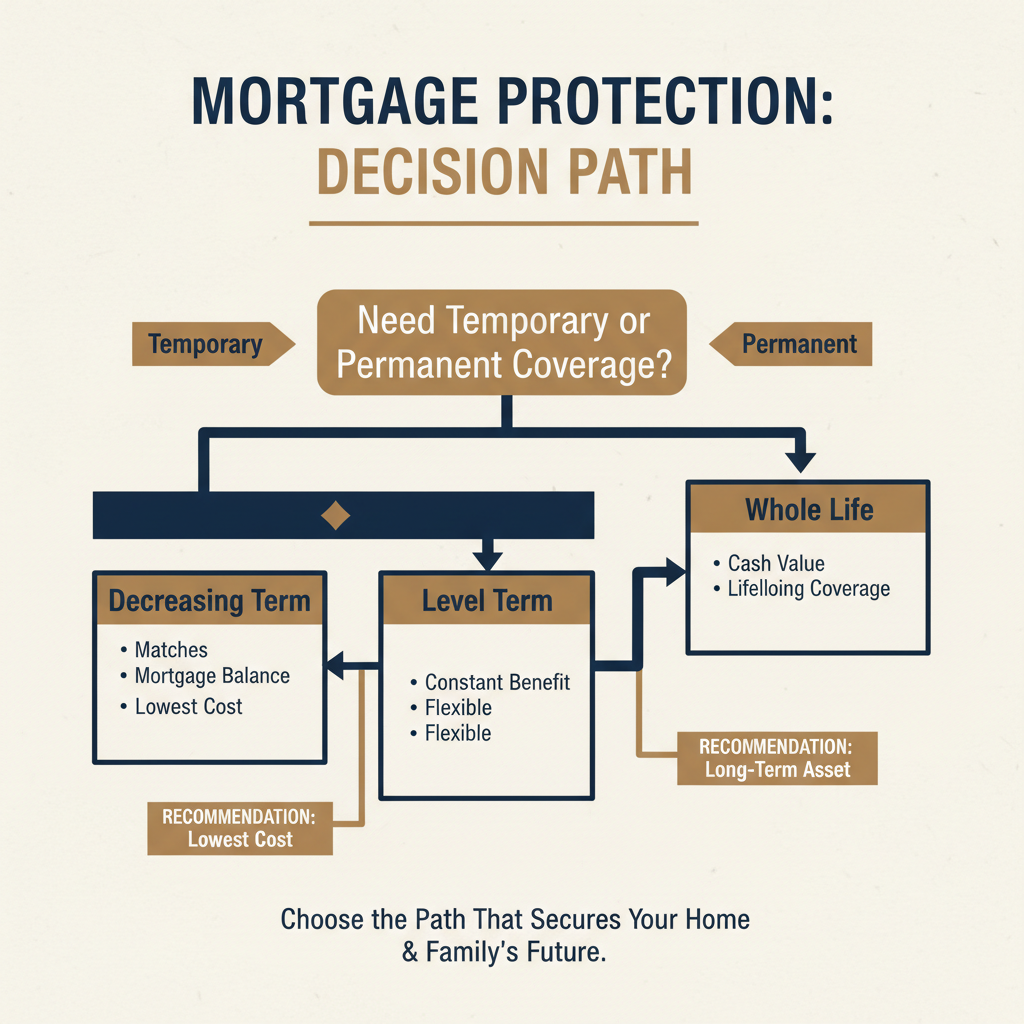
Mortgage protection can be structured as decreasing term (benefit declines with mortgage balance) or level term (fixed benefit throughout). Decreasing term matches your mortgage amortization — the death benefit starts at your loan amount and decreases annually, reaching zero when the mortgage is paid off. Premiums are 20-30% lower than level term because the insurer's risk decreases. Decreasing term is pure mortgage protection — it covers exactly what you owe, no more, no less. Level term provides a fixed death benefit that doesn't change. If you have a $300,000, 30-year policy, beneficiaries receive $300,000 whether you die in year 1 or year 30. Level term offers more flexibility — beneficiaries can pay off the mortgage and have remaining funds for other expenses, or keep the mortgage and use funds for living expenses, education, or retirement. Level term premiums are higher but provide more value and options. Most financial advisors recommend level term over decreasing term because: it provides flexibility if circumstances change, your family can adapt the benefit to their needs, and the additional cost is modest relative to the extra value. Decreasing term makes sense only if you want pure mortgage payoff with no excess and budget is extremely tight. Consider your family's overall financial picture when choosing between these structures.
When Should I Buy Mortgage Protection?
The ideal time to buy mortgage protection is when you purchase your home or refinance — locking in coverage while you're young, healthy, and insurable. At mortgage closing, you're typically at your most insurable age, and premiums are lowest. Waiting even a few years can significantly increase costs or make you uninsurable if health conditions develop. Many people focus on the mortgage itself and neglect protection, assuming they'll "get around to it" later. This procrastination is risky — health changes can make coverage impossible or prohibitively expensive. If you already have a mortgage without protection, buy a policy now rather than waiting. Even if you're older or have health issues, some coverage is better than none. Mortgage protection is especially critical if: you have young children dependent on your income, you're the primary breadwinner, your spouse couldn't afford payments alone, you have limited savings to cover payments during transition, or you have health concerns that might worsen. Don't wait for a "better time" — the best time is now, while you're alive and potentially insurable. Many carriers offer simplified issue mortgage protection with no medical exam, making coverage accessible even with health conditions. The small monthly premium provides enormous peace of mind that your family's home is secure.